Thursday, September 16, 2021

Dad's Guide to Bottle-feeding Breastmilk

As our world has changed over the last two years with more parents are working from home and sharing the responsibility of feeding the baby.  My own son is expecting his first and his wife will be working outside the home while he runs his business from home.  

Since babies don't come with an instruction manual, Dads and other caregivers can benefit from some advice on feeding while mom is away.

#1.  Introduce the Bottle at 6-8 Weeks

This time frame is optimal because it allows enough time for mom and baby to establish a good latch and breastfeeding rhythm.  Waiting longer than 6-8 weeks can sometimes make it more difficult for baby to want to transition from breast to bottle.  The goal is to use this window of opportunity so that baby goes back and forth from breast to bottle seamlessly.  

#2.  Choose the Bottle with Intention

The intention behind choosing a bottle is that the nipple had a wide mound so that baby opens wide simulating the same latch as they would on the breast.  The bottle nipple should be silicone and not rubber that has a smell and taste and should be a slow flow or newborn nipple.  Some recommended bottles and nipples are Spectra, Motif Luna, Hygeia and Comotomo.  

#3.  Schedule an Introductory Trial Run

It may be difficult for Dad or any caregiver to try to introduce a bottle with mom is nearby.  Plan a time that mom has a short outing and when it has only been 2 hours since the baby has fed.  Waiting until the three hour mark increases the infant's agitation and willingness to try a new way of feeding.

#4.  Position Baby

Make sure the baby's head is above their body.  Most images you see of bottle feeding have baby in a cradle hold with the bottle above them which can be effective.  When using a cradle hold, the crook of your elbow is lifted so you may want an extra pillow on the armrest so your arm doesn't get fatigued in that position.  If the infant is refusing the bottle in this position, there are several other positions to try.  One is to simulate the position at the breast, hold baby tummy to tummy with you and hold the base of the bottle close to your chest.

#5.  Take it Slow

It is important to slow down the feedings as bottles drip automatically and can cause the infant to feed too quickly getting more air and taking in more breastmilk than mom is producing.  One way to slow the feeding is to stop and burp after each ounce.  

It is important not to offer baby more than the appropriate amount for weight gain or you may undermine moms confidence in her milk production.  So the next question is, how much does the baby need?  To calculate the infant's need, take the baby's weight and multiply by 2.5 which will give you the number of ounces per day. Divide this number by the number or feeding per day which is normally eight.  This will give you the number of ounces per bottle.  But who has time to do math with a new baby in the house so below is a handy chart for you to use.

Once the baby gets used to the bottle, it can be daunting if they finish quickly and still act as if they are hungry.  It is evident a baby over 6 days of age is getting enough by the wet diapers which should be 6-8 per day.  The number of dirty diaper can vary but generally 3-4 per day up to 3 months and then can slow down to one every three to five days. It is also important to know that an infant going through a growth spurt which is typically 3 weeks, 6 weeks, 3 months and 6 months will act hungry and mom may need to increase her pumping schedule for 5 days in a row to boost her supply to match the baby's demand.

#6.  Know How to Handle Breastmilk

As anytime you feed an infant, you will want to wash your hands.  But there is much more to know about how to handle breastmilk when it comes to storage, thawing and feeding.  

Breastmilk is good at room temperature for 4 hours, but if the baby pauses a feeding it needs to be used within a 2 hour window.  It is good in the refrigerator for 4 days, but you should then use it and not freeze it as you have used up the life of the milk.  It is good in a freezer for 6-12 months but you should not store it in the door and you should never re-freeze thawed breastmilk.

When thawing breastmilk, it is best to do this in the refrigerator overnight, on the counter for three hours or in a container of warm, not boiling hot water.  You can also use a commercial bottle warmer provided it has a thermostat reading as breast milk is best served between 77 degrees and 98.6 degrees Fahrenheit for optimal digestion. If you are thawing breastmilk, use the oldest milk first.

Use fresh milk whenever available.  While it seem reasonable for mom to pump and stockpile her freezer, using frozen stock on the first workday of the week is good, but the rest of the week use Monday's expressed milk to serve on Tuesday, etc.  The reasoning behind this is that freshly expressed breastmilk has living white blood cells in it that are no longer living when frozen. Don't get me wrong, frozen milk is still far superior in nutrition and antibodies than artificial infant milk, but the fresh milk is optimal in those while blood cells providing greater active immunities for your baby.  In addition, breastmilk changes over the months so that as the baby grows and the needs of the baby grow, the milk expressed at that time is age appropriate in it's benefits as shown on the infographic below.


#7 Encourage Mom

Expressing breastmilk for baby takes time and commitment.  Remind mom that she is leaving her baby a gift every time she leaves breastmilk for a feeding.  Breastmilk is liquid gold and liquid love for her baby and this provision can help mom in the transition from being home to being away from her precious infant. Another bit of encouragement and boost to milk supply is to pack her bag with a water bottle, nutritious snack or lactation cookie bar. And of course a nice note in her pump bag every now and then never hurts!


Best wishes for Bottle Feeding Breastmilk!

Tanya


P.S.  Feel free to leave questions!


Monday, August 30, 2021

Which Bottle Nipples are Best for Breastfeeding?

Recently a question came in from an expectant mama as to whether the Avent bottles were best for breastfeeding.      

In years past, I recommended Avent bottles more often than not.  Today, with design changes to Avent and other great choices on the market, I thought I would help this mother and others with information on choosing the right bottle for your baby with today's blog.

Nipple Confusion and Flow Preference

First, let me say that introducing a bottle before six weeks can be problematic.  It is essential that your baby learn to latch well and nurse from the breast frequently during not only the learning period but also during the three week and six week growth spurt phase so that mom's milk supply can be stimulated by the increased suckling during those time periods.  Infant's nurse differently from a bottle which is why the term nipple confusion is prevalent.  When nursing from the breast, the baby uses a wave motion to draw the nipple into the mouth, but when using a bottle the baby traps the bottle nipple in the roof of the mouth or thrusts the tonged toward the bottle nipple opening to control the overwhelming flow from the bottle. In addition, feeding from a bottle gives the infant immediate gratification whereas the infant must suck for approximately 30-60 seconds from the breast to achieve let-down. As human beings, we tend to prefer immediate gratification even thought this is not best for the infant.  Suckling at the breast aids in tooth and jaw development in addition to many other benefits. If there is a medical need to supplement prior to the six week mark, a feeding syringe is best to avoid preference of a faster flow.  See our blog post on syringe feeding.


Introducing a Bottle

Once the infant has passed the six week growth spurt and you are ready to introduce a bottle, the type of bottle nipple used can make for a smoother transition from breast to bottle and vice versa.  I always recommend silicone slow flow nipples with a large area for the baby to latch.  See image below for an example of this type of bottle nipple.  

Shallow or narrow nipples do not allow for the infant to flare out or rosebud their lips like they do on the breast. Or at least not onto a soft are but only only onto hard plastic.  This shallow nipple discourages infants to take enough of the nipple into their mouths.  This behavior can transfer to breastfeeding causing the infant to only take moms nipple and not at least the recommended inch of the areola into their mouth.  If this shallow latch happens on the breast, it causes nipple pain in mom and poor milk transfer for the infant.  The milk transfer is not well achieved unless the infant latches onto the areola where the breastmilk pools in the milk sinuses.  Pacifiers with this breast-like shape are also recommended such as the Ninni Co Pacifier.

Below are some links to bottles and nipples that meet the criteria for the infant to latch well onto the bottle and back onto the breast:

Spectra Bottles with Nipples

Motif Luna Bottles and Motif Luna Nipples

Many experts believe that in addition to a wider base, a graduated sloped shape is recommended such as the Evenflo Balance Nipples as optimal for infants.  


Nipple Flow

In addition, breast fed babies feed more efficiently due to their increase in jaw development so there is no need for a higher volume flow when purchasing nipples.  You only need to purchase slow flow or newborn nipples in most cases unless your baby has suck difficulty or tongue tie, etc.  Bottle companies often put an age range on nipples to encourage moms to purchase more from the company, but you only need to replace nipples when they yellow or if they drip too quickly. If you baby needs an even slower flow, the Pigeon Super Slow Flow can be very beneficial and it is compatible with Spectra, Motif and Lansinoh wide-mouth bottles as well as the Evenflo Balance + GLASS bottle.

Pigeon Nipples


Best wishes as you prepare for baby!

Tanya


Friday, April 16, 2021

Back to Breastfeeding: Transitioning from Bottle to Breast


Recently, we had a question from a mother whose baby was unable to nurse from the breast effectively because of a severe tongue tie.  From experience, we know she is not the only mom with questions about how to get a baby who has been bottle-fed for weeks back on the breast so our hope is that this blog post helps Bev and the other moms in her situation.

There are several things you can do to encourage an infant who is bottle feeding to take the breast.  One size never fits all in counseling nursing mothers, so we will outline a myriad of techniques so that you can find one the one that helps you the most.

Start by changing the way you supplement.  The best method is to go from a bottle to finger feeding with a syringe.  A 10cc syringe is 1/3 of an ounce.  This will help you determine how many times to fill the syringe for a feeding.  When finger feeding with a syringe, put your feet up on a stool and lay the baby on your lap facing you.  Then insert a clean finger, pad side up.  Once the baby begins suckling, place the syringe in the corner of their mouth and wait for 30-60 seconds before tapping the baby feeding syringe.  Syringe feeding will help the baby use his tongue properly instead of arching or thrusting his tongue as when bottle feeding.  This method also slows down the feeding unlike a dripping bottle so that there is not immediate gratification but instead proper suckling several times, then yields the result of you tapping the syringe and releasing the milk.  This is important because it takes 30-60 seconds for breast milk to be released.  


Change the way you bottle feed.  If syringe feeding is not feasible, especially if your infant is in child care while you work, you can change the way that bottle feeding is done so that it can help as well. Holding a bottle fed baby the same way as you would feed a nursing infant can help transition the baby from bottle to breast. This means the baby should be tummy to tummy with you while feeding from a bottle.  Hold the bottle close to your collar bone so that the infant is not on its back when feeding.  Make sure the infant has lips wide apart.  If clamping the tip of the bottle nipple, gently screw the bottle in like a lightbulb and it will help the infant rosebud their lips.  If an infant does not open wide on the bottle, they will not open wide at the breast and milk transfer will be inefficient.  The milk sinuses are located about an inch behind the nipple so a wide mouth is essential in breastfeeding effectively.

Take advantage of prime time opportunities.  There are several times when infants are more disposed to breastfeeding.  These are times when their natural instincts kick in.  These times include falling asleep, not yet fully awake and when mom and baby are in a warm bathtub together.  Have a syringe full of breastmilk available when taking advantage of these prime time opportunities and that way you can drip breast milk on your nipple (you can also hand express first instead).  Lay the sleepy or bathing infant at your breast with your nipple exposed and gently guide them to nurse.

Try a nipple shield.  A baby who is used to the feel of a silicone nipple in their mouth may not respond to a bare nipple.  A nipple shield is one way to transition.  Make sure that you change your bottle feeding position from baby on their back to tummy to tummy for at least 2-3 days prior to trying the nipple shield.  Wet the nipple shield to help it adhere.  Massage your breast so that milk begins to drip into the nipple shield before attempting to latch.  Please note that if you are using a nipple shield for more than a few days, you will need to use a breast pump 1-2 times per day since it is a physical barrier that can lower milk supply without the added stimulation of pumping.

If your milk supply is low, use a lactation aid feeding tube.  If you are getting your baby latched, but they keep disengaging because milk is not flowing, a lactation aid feeding tube which can draw from a syringe or a bottle for supplement can help keep the baby at the breast.

Remember, your baby prefers you!  It is often such a blow to our ego as a mom, when a baby refuses the breast.  Your thoughts are that the baby prefers the bottle.  Just know, this is not a personal rejection.  Your baby has just learned another habit of feeding.  The good news is that babies learn habits quickly, so they can also quickly change their habit. But even if your baby never learns to nurse from the breast, you are still their favorite! And any means that you can use to get breastmilk in your baby is a win!

Be patient.  Try these techniques, then try them again.  Use what works, and toss what doesn't work for you and your baby.

Here is to a good latch!

Tanya


Friday, March 26, 2021

Is a Wet Dry Bag for Breast Pump Parts a Good Idea?

With all the things you need to buy for baby, is purchasing a dry bag for breast pump parts a waste of money or a good idea? That all depends on whether the bag is actually made in a way to promote healthy drying of your pump parts so we will look at the most common questions moms ask about breast pump parts bags.


Can I use a Ziplock bag?

You should use a sealed plastic zipper bag for your wet breast pump parts.  Besides the environmental concerns of over-use of these bags, the main reason is that moisture and warmth promote the growth of yeast and mold and that is certainly not what you want for parts that are collecting your baby's precious breastmilk. So to answer another common question, do breast pump parts need to be dry?  As you can see from the previous topic of yeast and mold...yes!


What about wet dry bags?

Wet dry bag were designed to put in wet clothing such as your baby's soiled clothes or a swimsuit and keep the rest of the items in your bag dry.  Although you see them marketed as "breast pump  parts bags", they are not any healthier than Ziplock bags as shown below where one brand is obviously growing mold. In my option, while the cute prints of these wet dry bags are enticing, they are a complete waste of money if you are using them for breast pump parts rather than soiled baby clothes.


What should I use?

Bags that have a small weave, but are fully breathable are best for air drying breast pump parts.  We love this one by Breastmilk Bandit.  The Breastmilk Bandit Store and Dry Bag is made with fine breathable mesh, a durable zipper and even a hang-dry loop so breast pump parts dry even faster.  If you are are trying to get Medela tubing dry, the hang-dry method is optimal.   Attaching tubing to your pump and letting it run may work, but it wears out your pump faster and it is much less expensive to replace tubing than the breast pump.


Alternatives that do work are bags like the one below by Pumpin' Pal.  The pros are that it is priced a dollar or two less, but it is draw string instead of the more secure zipper closure that Breastmilk Bandit's bag offers. Air dry bags such as the one from Breastmilk Bandit are less expensive that wet dry bags like the one from Sarah Wells and are a much healthier way to store and dry your breast pump parts.


Here is to safe drying!

Tanya

_________________________________________________

2024 UPDATE!  

Breastmilk Bandit Air Dry Bag now includes a carabiner so you can clip to hang dry anywhere!


Thursday, March 25, 2021

Best Breast Pump Bags for Work or Travel

One of your most important purchases if you are pumping on the go for your baby, other than your breast pump is your breastmilk cooler bag!  Getting the right bag is essential for protecting your liquid gold!

What should you look for in a breast milk cooler bag?  You want a well insulated bag with a good tight zipper that will hold enough breast milk for your baby at daycare of for your day of pumping.  Below are some tried and true cooler bags that we recommend for our nursing mothers.

4 Bottle vs 6 Bottle Breastmilk Cooler

If you work part-time, a 4 bottle bag is sufficient; but for a full 8-10 hours between work and home, you will want a six bottle cooler.  The main reason for this is that you can pump three different times into different bottles so your 98.6 degree milk doesn't warm up previously chilled breast milk.  You can consolidate your expressed milk later, but you always need to chill breast milk prior to adding to previously pumped and chilled milk to avoid reducing the longevity of the previously expressed breastmilk.

JuJuBe offers several high quality bottle bags that can be used for breast milk storage.  One is the JuJuBe Fuel Cell and the other is JuJuBe Be Cool.  They will both hold ice packs and up to 4 wide mouth bottles in a stacked position.

Pros:  Holds up to 4 wide mouth bottles and 2 ice packs. Stylish bag can be used as a lunch bag for mom or school-age child.

Cons:  Bottles must be in a stacked position, which may not be convenient for every situation.

Ameda offers an excellent breastmilk cooler cooler bag that includes three ice packs.  It can hold up to six standard bottles and three ice packs, but will not fit with bottle caps.  If using wide-mouth bottles, you can only fit 4 instead of six.

Pros:  Holds up to 6 standard bottles and 3 ice packs. 

Cons:  Only holds 4 wide-mouth bottles and is not tall enough to use with bottle caps if you are transporting bottles with nipples to child care.

Breastmilk Bandit has a great insulated breast milk cooler bag that holds up to 6 standard or wide mouth bottles and is tall enough to accommodate bottle caps to transport bottles with nipples to day care. This bag is perfect for use with breast pumps that include wide mouth bottles such as Spectra bottles, Ameda Mya bottles and Motif Luna bottles.

Pros:  Holds up to six 5oz standard or wide mouth bottles and 3 ice packs and is tall enough for caps to transport bottles with nipples to day care.  

Cons:  Because of the 6 bottle capacity, it is slightly larger than most cooler carriers so will most likely not fit inside a standard breast pump tote bag.  One suggestion is to use a carabiner clip so that you can attach it to your bag while you are on the go.


What about ice packs?

Gel Ice Packs vs Blue Ice Packs

There is a big difference with how long breast milk will stay cold in your Breastmilk Cooler Carrier when you choose a soft or gel ice pack vs a hard ice pack also known as blue ice.  The gel packs just do not stay frozen long enough to get you past lunch-time in even the best cooler carrier.  Hard ice packs are the best choice.  Choosing a slim hard ice pack and using at least 2 for 4 bottles and 3 for 6 bottles will allow you to fit the optimal amount of ice packs and bottles into these cooler carriers so that your milk stays cold for 8-10 hours as needed.

What about freezable breast milk cooler bags?  Unfortunately, cooler bags that are freezable also use a soft gel ice pack sewn into the bag which does not keep the breast milk cold long enough for the pumping working mother.


As always, I hope this blog helps you navigate your pumping needs.  Happy transporting!
Tanya


Wednesday, January 13, 2021

Technology in Breast Pumps - Spectra Synergy Gold SG Dual Powered Breast Pump -

We were first notified of the latest innovation in breast pumping technology and have been waiting to get our hands on their incredible new breast pump, the Spectra Synergy Gold.  This pump has dual power, not to confused with just dual or double pumping.  It actually allows the breasts to be stimulated independently so you can increase the suction on the lazy breast to encourage more milk extraction.  This type of technology is what double pumps were going for when they were first invented by Einar Egnell, founder of the Ameda Egnell company back in 1942.  But not much has changed in this field other than portability and speed.  Dual electric pumps became smaller, faster, more portable and some are even wearable. As I said, not much has changed, until now!

What is different about the Spectra Synergy Gold Breast Pump is that is had dual motors that operate independently.  Why is that helpful?  Double pumping increases prolactin for increased milk production, but until now each breast had to be treated the same.  The same number of sucks per minute at the same level of suction.  But as you know, your breasts aren't twins - they are more like sisters.  Allowing for each breast to be treated individually allows you to increase suction more on one breast.  Think of this pump more like nursing twins.  Even twins have different needs when it comes to pace of feeding and different abilities when it comes to strength of suction.  

While the new Spectra Synergy Gold Breast Pump has the most advanced technology in the industry, it has retained the hallmark features for which Spectra is known.  The Synergy Gold has a true closed system with a hygienic barrier to prevent breast milk contamination, has a mild indirect light for breastfeeding at night or use as a night light, and uses the same Spectra accessory kit as other Spectra breast pumps so if you are upgrading to the Synergy Gold Breast Pump, your Spectra breast pump parts and Spectra bottles are compatible.  And Spectra offers 20mm, 24mm 28mm and 32mm genuine Spectra breast shields.  

The Spectra Synergy Gold Breast Pump offers the same 270 mmHG strength of suction as the Hospital Grade Spectra S3 Pro.  It is ultra quiet and has a timer control, 3 levels of light illumination, LCD touch screen with dual controls for each breast, timer and mute mode.

So you can see the difference between the Spectra Synergy Gold settings vs the Spectra S2 as well as other pumps, below is a chart showing the details of the strength of suction and speed of this exceptional breast pump!


And I may be a lactation nerd, but can I say this pump is sexy!  Love the name of this pump and white and gold color scheme which makes you feel like a lactation professional even if you aren't one...lol! After all the definition of synergy is a cooperative action between two in order to produce a combined effect greater than the sum of their separate effects. Like most of you, we were happy to have 2020 in our rearview mirror for a myriad of reasons and are happy to have the Spectra Synergy Gold Breast Pump now available!

Synergy Gold breast pump parts are similar to the tried and true Spectra S1 and S2 breast pump parts with the exception of specialized SG tubing.  Spectra white duckbill valves and backflow protectors are the same in the Synergy Gold.  Replacement Synergy Gold Breast Shield Sets with SG tubing can be purchased as well.  

Here is to more effective pumping!

Tanya

www.lactationconnection.com


Thursday, January 7, 2021

Breastfeeding Positions: Laid Back, Side-Lying, Cross-Cradle, Football Hold

I recently came across some great diagrams and information on breastfeeding positions from a Chinese source!  Their hospital authority breastfeeding promotion committee had these wonderful images and descriptions to offer, so I had to share! I added the American names for the transitional position as Cross-Cradle Hold and underarm position as Football Hold, but the rest is straight from ha.org. 

Happy Reading!

Tanya

www.lactationconnection.com


 Laid back position

  • The mother is to lean back and be well supported on a bed or couch. When putting the baby on the mother's chest, gravity will keep him / her in position and the body molded to the mother's.
  • Have the mother’s head, back and elbows well supported with cushions / pillows. Let the baby’s cheek rest somewhere near the mother's bare breast. The whole front of the baby’s body should touch the mother's whole front.
  • The baby can rest in a position that the mother likes, just making sure that his / her whole front is against the mother's.
  • The advantages of this method are that the baby can instinctively take the initiative to find the breast and suckle, while the mother can assist and encourage the baby in a relaxed manner.
  • This method is particularly suitable when the mother is a bit tired. But if the mother is exhausted or under the influence of medication after childbirth, taking into account the safety of the baby in case if the mother falls asleep, it is preferable to have a family member to stay at the bedside to take care of and observe her.
  • If the flow of the mother’s milk is too fast, this method can also slow down the rate through gravity.

Laid Back Position

Transitional (Cross Cradle Hold)

  • The mother should sit straight, with her back resting on a chair. Her body should slightly lean forward without bending too much of the back and neck. A foot pedal or beveled stool can be placed under her feet for support.
  • The mother is to cradle or hold the baby across her lap, with the baby lying on his / her side. He / she should be resting on his / her shoulder and hip, with the mouth levels with the nipple of the mother.
  • Pillows / cushions are to be used to lift the baby and support the mother’s elbows to bring the baby up to the nipple height especially during the first few weeks.
  • The mother can support her breast using either a "U" or "C" hold, using the hand on the same side of her breast.
  • The baby's head will be on the mother’s opposite forearm and his / her back will be along mother’s inner arm and palm.
  • When the mother looks down, she should see her baby's side.
  • She can put the baby's head on the breast when he / she widely opens the mouth instead of placing the nipple into it. In good attachment, the baby’s lower lip should turn outward and cover the areola below. The chin is indenting the breast. More areola will be seen above the top lip than the bottom lip if the areola is seen.
  • Be sure that the baby's ear, shoulder and hips should be in a straight line. As a newborn, the baby's head and bottom should be at the same level.

Transitional hold

Side-lying position

  • Lying down is a comfortable position for many nursing mothers, especially at night.
  • When using this method, both the mother and baby are to lie on their sides facing each other.
  • The mother's head is to be supported. To help her getting comfortable, she can use pillows behind her back and bottom or between her knees.
  • During the positioning, the mother can use her hand to keep the baby's back in position. In helping the baby in getting milk more easily, the mother can keep the baby's hips flexed and his ear, shoulder and hip in one line.
  • The breast can be supported with a "C" hold, using her hand on the opposite side of the breast.
  • Same as in transitional hold, instead of placing the nipple into the baby’s mouth, the mother can put the baby's head on the breast when he / she widely opens it. In good attachment, the baby’s lower lip should turn outward and cover the areola below. The chin is indenting the breast. More areola will be seen above the top lip than the bottom lip if the areola is visible.
  • After the baby is well positioned and attached to the breast, the mother should remove her supporting hand from the baby’s back and rest it beside her own head.
  • To prevent the baby from rolling away from the mother, a pillow or rolled blanket can be placed behind the baby's back to support his / her position.
  • If this method is used when the mother is very tired or under the influence of medication, it is advisable to have the companion of a family member to stay at the bedside to take care of and observe her. This will avoid jeopardizing the safety of the baby if the mother falls asleep during feeding.
  • This position is also useful during daytime.

Side-lying position

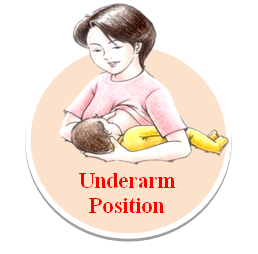
Underarm Position (Football Hold)

  • Keeping the baby away from the incision, this is a good position for a mother who has had a Caesarean birth
  • Most newborns feel comfortable in this position. It also helps when a mother has a forceful milk ejection reflex (let down) because the baby can handle the flow more easily.
  • When adopting this position, the mother’s body should slightly lean forward without too much bending of her back and neck. A foot pedal or beveled stool can be placed under her feet for support.
  • To facilitate a good control on the baby’s position, the mother is to support the baby's head in her hand and the baby’s back along her arm beside her. The baby's legs and feet are tucked under the mother’s arm, with his hips flexed and his legs resting alongside the mother’s back rest. The baby’s chest should now be facing the mother’s breast, with his mouth at nipple height.
  • The breast can be supported with a "C" hold, using her hand on the opposite side of the breast.
  • The mother can put the baby's head on the breast when he / she widely opens the mouth. Do not try to place the nipple into the baby's mouth. In good attachment, the baby's lower lip should turn outward and cover the areola below. The chin is indenting the breast. More areola will be seen above the top lip than the bottom lip if the areola is visible.
  • If needed, pillows could be used to bring up the baby to the correct height and to reduce the pressure on the mother’s arm and wrist. However, to avoid the mother leaning forward excessively, the pillow support should not be placed at too low a level.

Underarm position

Source of above diagrams: Hospital Authority Breastfeeding Promotion Subcommittee

Wednesday, December 9, 2020

How to Increase Milk Supply - From Galactagogues to Good Latch and Pumping to Pacifiers plus More!

How to increase milk supply is something most moms want to know at one time or another during their breastfeeding journey and with good cause.  Whether a growth spurt or just life circumstances in general have you feeling like you are behind in production, it can happen.  Today, I want to outline not only how to increase breast milk supply, but also how to protect your milk supply so you don't have to play catch up.


Feed on demand and don't delay feedings.

Breast milk is produced by supply and demand or should I say, demand and then supply.  Feeding frequently and in full (fully emptying breasts) protects your milk supply from sudden dips. Growth spurts are waves that should be ridden.  In other words an infant who is 10 days to 3 weeks of age will begin his first growth spurt and instead of nursing 8 time per day will nurse 11-12 times per day.  If you are exclusively pumping, you should increase your pumping sessions to match this for 5 days in a row every time a growth spurt would naturally occur in your baby.  The normal times for growth spurts are 3 weeks, 6 weeks, 3 months and 6 months.

A good latch or a good fitting breast flange is essential to your milk supply.

When feeding your baby, you need to consider not only how often, but how well your baby is feeding. Your baby should have flanged lips and at least an inch of the areola drawn into his mouth in order to effective drain the breasts.  Breasts that are not drained fully, do not produce as much breast milk because your body thinks you have left milk there because it is not needed.  The same goes with your breast pump flange.  If you do not have a breast flange that is fitted well enough to draw in the nipple, but also a portion of the areola, your milk supply will suffer.  

Offer both breasts at a feeding.

The same is true of how you manage your feedings.  Many moms will start out with an overabundant milk supply and because the baby is satisfied with only one breast, just leave it at that.  Milk supply ebbs and flows so it is very important to offer both breasts at a feeding for the sake of your future milk supply.  Babies may become snack nursers and cease to drain the breast properly if you don't offer the second breast.  It is fine for them to feed for a shorter period of time on the second breast, but offering it keeps them in the habit for when your milk supply regulates (after 6-8 weeks) and both breasts are needed to fully accomplish a feed.  For moms who are pumping, make sure you are double pumping with a good breast pump from a reputable company like Spectra or Ameda and that you pump for a full 10-15 minutes of double pumping to fully empty the breasts.

Don't overuse pacifiers.

While pacifiers have their time and place, using them too often can actually hinder your baby from non-nutritive sucking at the breast.  This non-nutritive sucking which usually occurs when they are falling asleep is essential for milk supply because of the oxytocin hormone that is produces during this time.

Nourish your body.

While drinking water does not make breastmilk, a dehydrated mother won't produce as much breastmilk.  Drinking to thirst and eating healthy helps your body perform optimally which includes producing more milk. While there are foods that are know galactagogues, it is hard to measure the intake needed of these milk increasing foods like oatmeal, etc.  They should be a part of your diet and snacks  and drinks that are formulated with them for nursing mothers like lactation cookies and lactation tea, are a great go to for a snack or fluid intake.  For increasing milk supply with galactagogues, however an encapsulated herb with appropriate dosage is easily measured and moms see an effective increase in milk production when using them.  One brand we recommend often is Legendairy Milk.  Legendairy offers herbal combinations tailored to specific needs and once that combination is identified, these capsules work quickly for most mothers.

Protect your milk supply.

Especially when a holiday or change occurs in your normal day to day or when your baby starts solid foods, it is important to protect your milk supply. Don't allow a change in schedule, to keep you from nursing or pumping. Infants under 6 months of age need to be fed at least eight times per day and over 6 months if they have started solid foods, at least five times per day.  Life happens, so if your regular timing (I hesitate to say schedule because if the baby want to eat early, you should nurse.) is disrupted, make up for it.  For example, a normal feeding or pumping session that would have occurred was missed or delayed so the next two feeding should be closer together so that at the end of the day, the same number of times the breasts were stimulated for milk products was achieved.  


Also, protect your milk supply by not offering solids before your baby is sitting up unassisted.  This usually occurs at about six months.  Not only will it help your milk supply long term to nurse exclusively for longer, but your baby will have the benefit of lower incidence of allergies.  You will also have an easier time feeding solids as infant loose their tongue thrust reflex at the same time as they learn to sit up.  Once solids have been introduced, it is also important to nurse first.  Always nurse before giving solids as breastmilk is the main source of nutrition for an infant under one year and the solids are a complement.  This also keeps green beans off your breast:)

Simulate a Growth Spurt

Babies naturally go through growth spurts to help mom increase her supply for their growing needs, but if you missed a growth spurt due to work or scheduling, you can still simulate one.  To do this, add 10-15 minutes of double pumping three times a day for five days in a row.  This extra stimulation has to be an hour apart from other feeding and pumping times and a day of these three extra pumping sessions must not be missed in order for your body to recognize it as a growth spurt and increase your supply.


Don't forget!

Enjoy your baby at the breast and the satisfaction of pumping when you are providing the precious gift of liquid gold to your baby.  It is also one of the few times, you get to sit down as a mom:)


Wishing you a healthy milk supply!

Tanya 

Mother of 3, Grandmother of 2, Retired IBCLC, Owner of Lactation Connection since 1993

www.lactationconnection.com


Thursday, October 22, 2020

Sterilizing and Cleaning your Pumpin' Pal Breast Pump Parts

One question moms ask is about cleaning their breast pump parts, specifically after-market parts that have been purchased to enhance their pumping experience.  A customers favorite is the Pumpin' Pal Super Shield because this pumping accessory allows for a wider range of breast flange sizes and also allow mom to sit back and pump due to its angled design.  But once the investment has been made in these, you do want to clean them properly to prolong the life of your breast pump parts.

Below are the recommendations from the manufacturer.

"Pumpin’ Pal Super Shields are made of BPA-free medical grade polypropylene and High Grade Platinum Silicone. Both can be boiled (do not let them sit on the bottom of the pan!) and steamed using a steam bag but that should only be done prior to first time use.  Caution: If microwaved too long to the point the water is steamed away, the parts may melt and become deformed. A couple of minutes of steam is plenty. From then on these products should be hand washed like china or a glass because you can easily clean all surfaces, unlike bottles and tubing.

They can be cleaned in a dishwasher on the top rack, but they will last much longer hand washing with warm water and a grease cutting dish soap as most automatic dishwasher detergents can etch the surface causing them to become “foggy”. In other words, you can clean the parts in the dishwasher, but we do not recommend it and we do not replace parts that are damaged in the dishwasher. Do not use any chemicals such as bleach to clean or sanitize the flanges."

In other words, sterilizing for 2-3 minutes in either boiling water or microwave steam sterilizer is appropriate before the first use.  After that, hand wash to prolong the life of your Pumpin' Pal super shield.  The good news is that these are easy to clean and often give you a much more comfortable experience when pumping!

If you are pumping multiple times per day, you can purchase the Pumpin' Pal Super Shields in individual sizes instead of a three size set.  The Pumpin' Pal Spectra Adapter and the Pumpin' Pal Silicone Super Shield Collar can also be purchased as replacement parts for your convenience.  Many moms like to have three sets  for work so they only have to clean them once per day.

Happy Pumpin'

Tanya

www.lactationconnection.com 


Wednesday, July 8, 2020

Best Microwave Sterilizer Bags for Baby Bottle and Breast Pump Parts

Especially now when we have seen viruses run rampant, moms want to know how to sterilize their breast pump parts.  Boiling was always an issue because it is so easy to get busy taking care of the baby and leave the breast pump parts boiling on the stove so long that they melt.  Microwave sterilization was the answer!  Back in the day, there was only one Microwave Sterilizer Bag made specifically for breast pumps and parts.  No, it was not the Medela QuickClean.  It was made by a breast pump company no longer in business called White River.  Of course, their bag was soon copied by Medela and others.  But as in most things, they are not all comparable.  The question is which bag is best?  Which holds the most?  Which is the made with the safest thick BPA free plastic?  Which bags are the best value for your money?


Here are our top picks!

#1 Ameda CleanEase - These bags are our favorite because of the superior RCPP thick plastic which is safer to use than thinner types of plastic, the easy slide closure, large cool touch area and the oversized bag that holds more than all the other bags we tested. Most bags will only hold three bottles or three breastshields and valves,  but this bag will hold four standard bottles or four breast shields.  They are also a great value since they come 7 bags to a package!

#2 Motif Micro-Steam Bags - These are a close second.  Also made of  the thick RCPP plastic, are about the same size as most brands with the same press to seal closure, but since they have 7 bags in a package are a better value than most other brands.

#3 ARDO Easy Clean - The ARDO bag is a close third because it is great quality and has a large 5.5" gusset similiar to the Ameda bag, but the availability online is not as good and the ARDO package only includes 5 bags.


For more details, take a look at our comparison chart above.  The commonality among these breast pump parts and baby bottle microwave sterilizer bags is that all may be used up to 20 times and they are all BPA free microwave sterilzer bags.  These bags are great for sterilizing all your microwave safe parts such as breast flanges, bottles and valves. 

Happy Sterilizing!
Tanya


Monday, April 20, 2020

APNO CREAM - ALL PURPOSE NIPPLE OINTMENT FOR BREASTFEEDING

If you have general tenderness or even trauma from a specific feeding, over the counter nipple creams such as lanolin cream,  Motherlove Nipple Cream or Bamboobies Nipple Balm are very effective.  But if you have ongoing soreness which cannot be resolved by a corrected latch, Dr Jack Newman has formulated an all-purpose nipple ointment or APNO cream that is a life-saver.

Copied with permission, the information below is essential in getting a prescription written for this cream as it does contain ingredients not found in any over the counter formulas.

There is a link in the information below or you can search for the term "compounding pharmacy near me" in order to locate a pharmacy that can make the formula once your doctor has written the following RX:

Mupirocin ointment 2%, 15 grams
Betamethasone ointment 0.1%, 15 grams
Add miconazole powder to a concentration of 2% miconazole
Combined yield about 30 grams
Directions:  Apply sparingly. Do not wash or wipe off.

Here is to nursing in comfort,
Tanya


THE “ALL-PURPOSE NIPPLE OINTMENT” OR APNO


We call our nipple ointment “all purpose” since it contains ingredients that help deal with multiple causes or aggravating factors of sore nipples. Breastfeeding parents with sore nipples don’t have time to try out different treatments that may or may not work, so we have combined various treatments in one ointment. Of course, preventing sore nipples in the first place is the best treatment and adjusting how the baby takes the breast can do more than anything to decrease and eliminate the breastfeeding parent’s nipple soreness. Please note that the “all-purpose nipple ointment” is a stop gap measure only and that the definitive treatment of sore nipples is to help the baby latch on as well as possible.

See these other information sheets: Sore NipplesLatching and Feeding Management.

THE APNO CONTAINS:


1. Mupirocin 2% ointment. Mupirocin (Bactroban is the trade name) is an antibiotic that is effective against many bacteria, including Staphylococcus aureus including MRSA (methicillin resistant Staphylococcus aureus). Staphylococcus aureus is commonly found growing in abrasions or cracks in the nipples. Mupirocin apparently has some effect against Candida albicans (commonly called “thrush” or “yeast”). Treatment of sore nipples with an antibiotic alone sometimes seems to work, but we feel that the antibiotic works best in combination with the other ingredients discussed below. Although some mupirocin is absorbed from the gut when taken by mouth, it is so quickly metabolized in the body that it is destroyed before blood levels can be measured. Most of it gets stuck to the skin so that very little is taken in by the baby.

2. Betamethasone 0.1% ointment. Betamethasone is a corticosteroid which decreases inflammation. By decreasing the inflammation, the APNO also decreases the pain the breastfeeding parent feels. Most of the betamethasone in the ointment is absorbed into the skin by the parent, so that the baby takes in very little.

3. Miconazole powder to a final concentration of 2%. Miconazole is an antifungal agent, very effective against Candida albicans. Because it is added as a powder, the concentration of miconazole can be increased to 3% or even 4% or decreased to less than 2%. We feel 2% is the best concentration for most situations. Fluconazole powder to 2% may be substituted for miconazole and so can clotrimazole powder to 2%, but I believe that clotrimazole (Canesten) irritates more than the other drugs in the same family. Miconazole cream or gel cannot be substituted for miconazole powder as the compound will usually separate. Where miconazole or any of the above mentioned drugs (fluconazole, clotrimazole) are not easily available as powders, it is better to use only the mupirocin and betamethasone ointments mixed together than add a cream or gel or nystatin ointment for example. By using a powder, the concentration of the other two ingredients is not as decreased as they would be if another ointment were used for the anti-fungal agent (for example, nystatin ointment). Thus, in the above preparation the concentration of the betamethasone becomes 0.05% (due to combination with the mupirocin) and the mupirocin concentration is decreased to 1%.

Note that nystatin ointment, which we used to use and which decreases the concentration of the other ingredients, is far inferior to miconazole and also tastes bad.

I write the prescription this way:

1. Mupirocin ointment 2%: 15 grams

2. Betamethasone ointment 0.1%: 15 grams

3. To which is added miconazole powder to a concentration of 2% miconazole

Total: about 30 grams combined. Apply sparingly after each feeding. Do not wash or wipe off.

NO SUBSTITUTIONS

If possible, it is best to get the prescription filled at a compounding pharmacy. You can find a list of compounding pharmacies by going to http://www.pccarx.com/. Click Find a compounder at the top, then add relevant information.

HOW TO USE THE OINTMENT:


1. Apply sparingly after each feeding. “Sparingly” means that the quantity of the ointment used is just enough to make the nipples and areola glossy or shiny.

2. Do not wash it off or wipe it off, even if the baby comes back to the breast earlier than expected.

HOW LONG SHOULD THE OINTMENT BE USED?


Any drug should be used for the shortest period of time necessary and the same is true for our ointment.  The all-purpose nipple ointment is a stop gap measure.  If the breastfeeding parent still needs the ointment after two or three weeks, or the pain returns after the breastfeeding parent has stopped the ointment, the parent should get “hands on” help again to find out why the ointment is still necessary. The most important step for decreasing nipple pain is still getting the “best latch possible.” Sometimes a tongue tie has not been noticed and is a reason for continued pain.

Some pharmacists have told breastfeeding parents that the steroid in the ointment will cause thinning of the skin if used for too long. While this is a concern with any steroid applied to the skin, we have not seen this happen even when breastfeeding parents have used it for months.

Updated by Dr. Jack Newman, June 2017

The information presented here is general and not a substitute for personalized treatment from an International Board Certified Lactation Consultant (IBCLC) or other qualified medical professionals.

This information sheet may be copied and distributed without further permission on the condition that you credit International Breastfeeding Centre and it is not used in any context that violates the WHO International Code on the Marketing of Breastmilk Substitutes (1981) and subsequent World Health Assembly resolutions. If you don’t know what this means, please email us to ask!

Dr Newman's Guide to Breastfeeding, 2014 Revised

Wednesday, March 11, 2020

Hygeia Fit Breast Pump - Breast Pump Replacement Parts

We were recently contacted by a mom looking for larger flanges for her Hygeia breast pump.  If you have the Hygeia EnJoye or Hygeia EnDeare breast pump, Hygeia breast pump parts are available at Lactation Connection. 

Please note that the Hygeia Evolve and FIT Pro use different parts! The accessory kit for the Hygeia Fit Pro which also works with the Hygeia Evolve is pictured below.


You can find the personal accessory kit and Hygeia Fit Pro breast pump parts here. Again, this kit also works with the Hygeia Evolve breast pump. 

In addition, the original Hygeia FIT breast pump you may have received through insurance called the Hygeia Fit (pictured below) does not work with the other Hygeia brand breast shields so you will need specific breast shields which are sold as Hygeia Fit 24mm Breast Shields or Hygeia Fit 28mm Breast Shields


Additional replacement parts are available for the Hygeia Fit Breast Pump including the Hygeia Fit Backflow Protectors, Hygeia Fit Duckbill Valves and the Hygeia Fit Tubing.  

For those looking for extra bottle for the Hygeia Fit breast pump, the following bottles are compatible:

Ameda Mya Bottles (not compatible with Mya Joy bottles)

Please note that the Hygeia Evolve and FIT Pro use different parts as well! The accessory kit for the Hygeia Fit Pro which also works with the Hygeia Evolve is pictured below.


You can find the personal accessory kit fand Hygeia Fit Pro breast pump parts here.

Happy pumping!
Tanya


Eufy vs Perifit Wearable Breast Pump