Thursday, January 7, 2021

Breastfeeding Positions: Laid Back, Side-Lying, Cross-Cradle, Football Hold

I recently came across some great diagrams and information on breastfeeding positions from a Chinese source!  Their hospital authority breastfeeding promotion committee had these wonderful images and descriptions to offer, so I had to share! I added the American names for the transitional position as Cross-Cradle Hold and underarm position as Football Hold, but the rest is straight from ha.org. 

Happy Reading!

Tanya

www.lactationconnection.com


 Laid back position

  • The mother is to lean back and be well supported on a bed or couch. When putting the baby on the mother's chest, gravity will keep him / her in position and the body molded to the mother's.
  • Have the mother’s head, back and elbows well supported with cushions / pillows. Let the baby’s cheek rest somewhere near the mother's bare breast. The whole front of the baby’s body should touch the mother's whole front.
  • The baby can rest in a position that the mother likes, just making sure that his / her whole front is against the mother's.
  • The advantages of this method are that the baby can instinctively take the initiative to find the breast and suckle, while the mother can assist and encourage the baby in a relaxed manner.
  • This method is particularly suitable when the mother is a bit tired. But if the mother is exhausted or under the influence of medication after childbirth, taking into account the safety of the baby in case if the mother falls asleep, it is preferable to have a family member to stay at the bedside to take care of and observe her.
  • If the flow of the mother’s milk is too fast, this method can also slow down the rate through gravity.

Laid Back Position

Transitional (Cross Cradle Hold)

  • The mother should sit straight, with her back resting on a chair. Her body should slightly lean forward without bending too much of the back and neck. A foot pedal or beveled stool can be placed under her feet for support.
  • The mother is to cradle or hold the baby across her lap, with the baby lying on his / her side. He / she should be resting on his / her shoulder and hip, with the mouth levels with the nipple of the mother.
  • Pillows / cushions are to be used to lift the baby and support the mother’s elbows to bring the baby up to the nipple height especially during the first few weeks.
  • The mother can support her breast using either a "U" or "C" hold, using the hand on the same side of her breast.
  • The baby's head will be on the mother’s opposite forearm and his / her back will be along mother’s inner arm and palm.
  • When the mother looks down, she should see her baby's side.
  • She can put the baby's head on the breast when he / she widely opens the mouth instead of placing the nipple into it. In good attachment, the baby’s lower lip should turn outward and cover the areola below. The chin is indenting the breast. More areola will be seen above the top lip than the bottom lip if the areola is seen.
  • Be sure that the baby's ear, shoulder and hips should be in a straight line. As a newborn, the baby's head and bottom should be at the same level.

Transitional hold

Side-lying position

  • Lying down is a comfortable position for many nursing mothers, especially at night.
  • When using this method, both the mother and baby are to lie on their sides facing each other.
  • The mother's head is to be supported. To help her getting comfortable, she can use pillows behind her back and bottom or between her knees.
  • During the positioning, the mother can use her hand to keep the baby's back in position. In helping the baby in getting milk more easily, the mother can keep the baby's hips flexed and his ear, shoulder and hip in one line.
  • The breast can be supported with a "C" hold, using her hand on the opposite side of the breast.
  • Same as in transitional hold, instead of placing the nipple into the baby’s mouth, the mother can put the baby's head on the breast when he / she widely opens it. In good attachment, the baby’s lower lip should turn outward and cover the areola below. The chin is indenting the breast. More areola will be seen above the top lip than the bottom lip if the areola is visible.
  • After the baby is well positioned and attached to the breast, the mother should remove her supporting hand from the baby’s back and rest it beside her own head.
  • To prevent the baby from rolling away from the mother, a pillow or rolled blanket can be placed behind the baby's back to support his / her position.
  • If this method is used when the mother is very tired or under the influence of medication, it is advisable to have the companion of a family member to stay at the bedside to take care of and observe her. This will avoid jeopardizing the safety of the baby if the mother falls asleep during feeding.
  • This position is also useful during daytime.

Side-lying position

Underarm Position (Football Hold)

  • Keeping the baby away from the incision, this is a good position for a mother who has had a Caesarean birth
  • Most newborns feel comfortable in this position. It also helps when a mother has a forceful milk ejection reflex (let down) because the baby can handle the flow more easily.
  • When adopting this position, the mother’s body should slightly lean forward without too much bending of her back and neck. A foot pedal or beveled stool can be placed under her feet for support.
  • To facilitate a good control on the baby’s position, the mother is to support the baby's head in her hand and the baby’s back along her arm beside her. The baby's legs and feet are tucked under the mother’s arm, with his hips flexed and his legs resting alongside the mother’s back rest. The baby’s chest should now be facing the mother’s breast, with his mouth at nipple height.
  • The breast can be supported with a "C" hold, using her hand on the opposite side of the breast.
  • The mother can put the baby's head on the breast when he / she widely opens the mouth. Do not try to place the nipple into the baby's mouth. In good attachment, the baby's lower lip should turn outward and cover the areola below. The chin is indenting the breast. More areola will be seen above the top lip than the bottom lip if the areola is visible.
  • If needed, pillows could be used to bring up the baby to the correct height and to reduce the pressure on the mother’s arm and wrist. However, to avoid the mother leaning forward excessively, the pillow support should not be placed at too low a level.
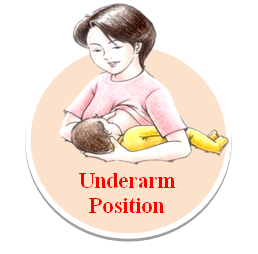
Underarm position

Source of above diagrams: Hospital Authority Breastfeeding Promotion Subcommittee

Wednesday, December 9, 2020

How to Increase Milk Supply - From Galactagogues to Good Latch and Pumping to Pacifiers plus More!

How to increase milk supply is something most moms want to know at one time or another during their breastfeeding journey and with good cause.  Whether a growth spurt or just life circumstances in general have you feeling like you are behind in production, it can happen.  Today, I want to outline not only how to increase breast milk supply, but also how to protect your milk supply so you don't have to play catch up.


Feed on demand and don't delay feedings.

Breast milk is produced by supply and demand or should I say, demand and then supply.  Feeding frequently and in full (fully emptying breasts) protects your milk supply from sudden dips. Growth spurts are waves that should be ridden.  In other words an infant who is 10 days to 3 weeks of age will begin his first growth spurt and instead of nursing 8 time per day will nurse 11-12 times per day.  If you are exclusively pumping, you should increase your pumping sessions to match this for 5 days in a row every time a growth spurt would naturally occur in your baby.  The normal times for growth spurts are 3 weeks, 6 weeks, 3 months and 6 months.

A good latch or a good fitting breast flange is essential to your milk supply.

When feeding your baby, you need to consider not only how often, but how well your baby is feeding. Your baby should have flanged lips and at least an inch of the areola drawn into his mouth in order to effective drain the breasts.  Breasts that are not drained fully, do not produce as much breast milk because your body thinks you have left milk there because it is not needed.  The same goes with your breast pump flange.  If you do not have a breast flange that is fitted well enough to draw in the nipple, but also a portion of the areola, your milk supply will suffer.  

Offer both breasts at a feeding.

The same is true of how you manage your feedings.  Many moms will start out with an overabundant milk supply and because the baby is satisfied with only one breast, just leave it at that.  Milk supply ebbs and flows so it is very important to offer both breasts at a feeding for the sake of your future milk supply.  Babies may become snack nursers and cease to drain the breast properly if you don't offer the second breast.  It is fine for them to feed for a shorter period of time on the second breast, but offering it keeps them in the habit for when your milk supply regulates (after 6-8 weeks) and both breasts are needed to fully accomplish a feed.  For moms who are pumping, make sure you are double pumping with a good breast pump from a reputable company like Spectra or Ameda and that you pump for a full 10-15 minutes of double pumping to fully empty the breasts.

Don't overuse pacifiers.

While pacifiers have their time and place, using them too often can actually hinder your baby from non-nutritive sucking at the breast.  This non-nutritive sucking which usually occurs when they are falling asleep is essential for milk supply because of the oxytocin hormone that is produces during this time.

Nourish your body.

While drinking water does not make breastmilk, a dehydrated mother won't produce as much breastmilk.  Drinking to thirst and eating healthy helps your body perform optimally which includes producing more milk. While there are foods that are know galactagogues, it is hard to measure the intake needed of these milk increasing foods like oatmeal, etc.  They should be a part of your diet and snacks  and drinks that are formulated with them for nursing mothers like lactation cookies and lactation tea, are a great go to for a snack or fluid intake.  For increasing milk supply with galactagogues, however an encapsulated herb with appropriate dosage is easily measured and moms see an effective increase in milk production when using them.  One brand we recommend often is Legendairy Milk.  Legendairy offers herbal combinations tailored to specific needs and once that combination is identified, these capsules work quickly for most mothers.

Protect your milk supply.

Especially when a holiday or change occurs in your normal day to day or when your baby starts solid foods, it is important to protect your milk supply. Don't allow a change in schedule, to keep you from nursing or pumping. Infants under 6 months of age need to be fed at least eight times per day and over 6 months if they have started solid foods, at least five times per day.  Life happens, so if your regular timing (I hesitate to say schedule because if the baby want to eat early, you should nurse.) is disrupted, make up for it.  For example, a normal feeding or pumping session that would have occurred was missed or delayed so the next two feeding should be closer together so that at the end of the day, the same number of times the breasts were stimulated for milk products was achieved.  


Also, protect your milk supply by not offering solids before your baby is sitting up unassisted.  This usually occurs at about six months.  Not only will it help your milk supply long term to nurse exclusively for longer, but your baby will have the benefit of lower incidence of allergies.  You will also have an easier time feeding solids as infant loose their tongue thrust reflex at the same time as they learn to sit up.  Once solids have been introduced, it is also important to nurse first.  Always nurse before giving solids as breastmilk is the main source of nutrition for an infant under one year and the solids are a complement.  This also keeps green beans off your breast:)

Simulate a Growth Spurt

Babies naturally go through growth spurts to help mom increase her supply for their growing needs, but if you missed a growth spurt due to work or scheduling, you can still simulate one.  To do this, add 10-15 minutes of double pumping three times a day for five days in a row.  This extra stimulation has to be an hour apart from other feeding and pumping times and a day of these three extra pumping sessions must not be missed in order for your body to recognize it as a growth spurt and increase your supply.


Don't forget!

Enjoy your baby at the breast and the satisfaction of pumping when you are providing the precious gift of liquid gold to your baby.  It is also one of the few times, you get to sit down as a mom:)


Wishing you a healthy milk supply!

Tanya 

Mother of 3, Grandmother of 2, Retired IBCLC, Owner of Lactation Connection since 1993

www.lactationconnection.com


Thursday, October 22, 2020

Sterilizing and Cleaning your Pumpin' Pal Breast Pump Parts

One question moms ask is about cleaning their breast pump parts, specifically after-market parts that have been purchased to enhance their pumping experience.  A customers favorite is the Pumpin' Pal Super Shield because this pumping accessory allows for a wider range of breast flange sizes and also allow mom to sit back and pump due to its angled design.  But once the investment has been made in these, you do want to clean them properly to prolong the life of your breast pump parts.

Below are the recommendations from the manufacturer.

"Pumpin’ Pal Super Shields are made of BPA-free medical grade polypropylene and High Grade Platinum Silicone. Both can be boiled (do not let them sit on the bottom of the pan!) and steamed using a steam bag but that should only be done prior to first time use.  Caution: If microwaved too long to the point the water is steamed away, the parts may melt and become deformed. A couple of minutes of steam is plenty. From then on these products should be hand washed like china or a glass because you can easily clean all surfaces, unlike bottles and tubing.

They can be cleaned in a dishwasher on the top rack, but they will last much longer hand washing with warm water and a grease cutting dish soap as most automatic dishwasher detergents can etch the surface causing them to become “foggy”. In other words, you can clean the parts in the dishwasher, but we do not recommend it and we do not replace parts that are damaged in the dishwasher. Do not use any chemicals such as bleach to clean or sanitize the flanges."

In other words, sterilizing for 2-3 minutes in either boiling water or microwave steam sterilizer is appropriate before the first use.  After that, hand wash to prolong the life of your Pumpin' Pal super shield.  The good news is that these are easy to clean and often give you a much more comfortable experience when pumping!

If you are pumping multiple times per day, you can purchase the Pumpin' Pal Super Shields in individual sizes instead of a three size set.  The Pumpin' Pal Spectra Adapter and the Pumpin' Pal Silicone Super Shield Collar can also be purchased as replacement parts for your convenience.  Many moms like to have three sets  for work so they only have to clean them once per day.

Happy Pumpin'

Tanya

www.lactationconnection.com 


Wednesday, July 8, 2020

Best Microwave Sterilizer Bags for Baby Bottle and Breast Pump Parts

Especially now when we have seen viruses run rampant, moms want to know how to sterilize their breast pump parts.  Boiling was always an issue because it is so easy to get busy taking care of the baby and leave the breast pump parts boiling on the stove so long that they melt.  Microwave sterilization was the answer!  Back in the day, there was only one Microwave Sterilizer Bag made specifically for breast pumps and parts.  No, it was not the Medela QuickClean.  It was made by a breast pump company no longer in business called White River.  Of course, their bag was soon copied by Medela and others.  But as in most things, they are not all comparable.  The question is which bag is best?  Which holds the most?  Which is the made with the safest thick BPA free plastic?  Which bags are the best value for your money?


Here are our top picks!

#1 Ameda CleanEase - These bags are our favorite because of the superior RCPP thick plastic which is safer to use than thinner types of plastic, the easy slide closure, large cool touch area and the oversized bag that holds more than all the other bags we tested. Most bags will only hold three bottles or three breastshields and valves,  but this bag will hold four standard bottles or four breast shields.  They are also a great value since they come 7 bags to a package!

#2 Motif Micro-Steam Bags - These are a close second.  Also made of  the thick RCPP plastic, are about the same size as most brands with the same press to seal closure, but since they have 7 bags in a package are a better value than most other brands.

#3 ARDO Easy Clean - The ARDO bag is a close third because it is great quality and has a large 5.5" gusset similiar to the Ameda bag, but the availability online is not as good and the ARDO package only includes 5 bags.


For more details, take a look at our comparison chart above.  The commonality among these breast pump parts and baby bottle microwave sterilizer bags is that all may be used up to 20 times and they are all BPA free microwave sterilzer bags.  These bags are great for sterilizing all your microwave safe parts such as breast flanges, bottles and valves. 

Happy Sterilizing!
Tanya


Monday, April 20, 2020

APNO CREAM - ALL PURPOSE NIPPLE OINTMENT FOR BREASTFEEDING

If you have general tenderness or even trauma from a specific feeding, over the counter nipple creams such as lanolin cream,  Motherlove Nipple Cream or Bamboobies Nipple Balm are very effective.  But if you have ongoing soreness which cannot be resolved by a corrected latch, Dr Jack Newman has formulated an all-purpose nipple ointment or APNO cream that is a life-saver.

Copied with permission, the information below is essential in getting a prescription written for this cream as it does contain ingredients not found in any over the counter formulas.

There is a link in the information below or you can search for the term "compounding pharmacy near me" in order to locate a pharmacy that can make the formula once your doctor has written the following RX:

Mupirocin ointment 2%, 15 grams
Betamethasone ointment 0.1%, 15 grams
Add miconazole powder to a concentration of 2% miconazole
Combined yield about 30 grams
Directions:  Apply sparingly. Do not wash or wipe off.

Here is to nursing in comfort,
Tanya


THE “ALL-PURPOSE NIPPLE OINTMENT” OR APNO


We call our nipple ointment “all purpose” since it contains ingredients that help deal with multiple causes or aggravating factors of sore nipples. Breastfeeding parents with sore nipples don’t have time to try out different treatments that may or may not work, so we have combined various treatments in one ointment. Of course, preventing sore nipples in the first place is the best treatment and adjusting how the baby takes the breast can do more than anything to decrease and eliminate the breastfeeding parent’s nipple soreness. Please note that the “all-purpose nipple ointment” is a stop gap measure only and that the definitive treatment of sore nipples is to help the baby latch on as well as possible.

See these other information sheets: Sore NipplesLatching and Feeding Management.

THE APNO CONTAINS:


1. Mupirocin 2% ointment. Mupirocin (Bactroban is the trade name) is an antibiotic that is effective against many bacteria, including Staphylococcus aureus including MRSA (methicillin resistant Staphylococcus aureus). Staphylococcus aureus is commonly found growing in abrasions or cracks in the nipples. Mupirocin apparently has some effect against Candida albicans (commonly called “thrush” or “yeast”). Treatment of sore nipples with an antibiotic alone sometimes seems to work, but we feel that the antibiotic works best in combination with the other ingredients discussed below. Although some mupirocin is absorbed from the gut when taken by mouth, it is so quickly metabolized in the body that it is destroyed before blood levels can be measured. Most of it gets stuck to the skin so that very little is taken in by the baby.

2. Betamethasone 0.1% ointment. Betamethasone is a corticosteroid which decreases inflammation. By decreasing the inflammation, the APNO also decreases the pain the breastfeeding parent feels. Most of the betamethasone in the ointment is absorbed into the skin by the parent, so that the baby takes in very little.

3. Miconazole powder to a final concentration of 2%. Miconazole is an antifungal agent, very effective against Candida albicans. Because it is added as a powder, the concentration of miconazole can be increased to 3% or even 4% or decreased to less than 2%. We feel 2% is the best concentration for most situations. Fluconazole powder to 2% may be substituted for miconazole and so can clotrimazole powder to 2%, but I believe that clotrimazole (Canesten) irritates more than the other drugs in the same family. Miconazole cream or gel cannot be substituted for miconazole powder as the compound will usually separate. Where miconazole or any of the above mentioned drugs (fluconazole, clotrimazole) are not easily available as powders, it is better to use only the mupirocin and betamethasone ointments mixed together than add a cream or gel or nystatin ointment for example. By using a powder, the concentration of the other two ingredients is not as decreased as they would be if another ointment were used for the anti-fungal agent (for example, nystatin ointment). Thus, in the above preparation the concentration of the betamethasone becomes 0.05% (due to combination with the mupirocin) and the mupirocin concentration is decreased to 1%.

Note that nystatin ointment, which we used to use and which decreases the concentration of the other ingredients, is far inferior to miconazole and also tastes bad.

I write the prescription this way:

1. Mupirocin ointment 2%: 15 grams

2. Betamethasone ointment 0.1%: 15 grams

3. To which is added miconazole powder to a concentration of 2% miconazole

Total: about 30 grams combined. Apply sparingly after each feeding. Do not wash or wipe off.

NO SUBSTITUTIONS

If possible, it is best to get the prescription filled at a compounding pharmacy. You can find a list of compounding pharmacies by going to http://www.pccarx.com/. Click Find a compounder at the top, then add relevant information.

HOW TO USE THE OINTMENT:


1. Apply sparingly after each feeding. “Sparingly” means that the quantity of the ointment used is just enough to make the nipples and areola glossy or shiny.

2. Do not wash it off or wipe it off, even if the baby comes back to the breast earlier than expected.

HOW LONG SHOULD THE OINTMENT BE USED?


Any drug should be used for the shortest period of time necessary and the same is true for our ointment.  The all-purpose nipple ointment is a stop gap measure.  If the breastfeeding parent still needs the ointment after two or three weeks, or the pain returns after the breastfeeding parent has stopped the ointment, the parent should get “hands on” help again to find out why the ointment is still necessary. The most important step for decreasing nipple pain is still getting the “best latch possible.” Sometimes a tongue tie has not been noticed and is a reason for continued pain.

Some pharmacists have told breastfeeding parents that the steroid in the ointment will cause thinning of the skin if used for too long. While this is a concern with any steroid applied to the skin, we have not seen this happen even when breastfeeding parents have used it for months.

Updated by Dr. Jack Newman, June 2017

The information presented here is general and not a substitute for personalized treatment from an International Board Certified Lactation Consultant (IBCLC) or other qualified medical professionals.

This information sheet may be copied and distributed without further permission on the condition that you credit International Breastfeeding Centre and it is not used in any context that violates the WHO International Code on the Marketing of Breastmilk Substitutes (1981) and subsequent World Health Assembly resolutions. If you don’t know what this means, please email us to ask!

Dr Newman's Guide to Breastfeeding, 2014 Revised

Wednesday, March 11, 2020

Hygeia Fit Breast Pump - Breast Pump Replacement Parts

We were recently contacted by a mom looking for larger flanges for her Hygeia breast pump.  If you have the Hygeia EnJoye or Hygeia EnDeare breast pump, Hygeia breast pump parts are available at Lactation Connection. 

Please note that the Hygeia Evolve and FIT Pro use different parts! The accessory kit for the Hygeia Fit Pro which also works with the Hygeia Evolve is pictured below.


You can find the personal accessory kit and Hygeia Fit Pro breast pump parts here. Again, this kit also works with the Hygeia Evolve breast pump. 

In addition, the original Hygeia FIT breast pump you may have received through insurance called the Hygeia Fit (pictured below) does not work with the other Hygeia brand breast shields so you will need specific breast shields which are sold as Hygeia Fit 24mm Breast Shields or Hygeia Fit 28mm Breast Shields


Additional replacement parts are available for the Hygeia Fit Breast Pump including the Hygeia Fit Backflow Protectors, Hygeia Fit Duckbill Valves and the Hygeia Fit Tubing.  

For those looking for extra bottle for the Hygeia Fit breast pump, the following bottles are compatible:

Ameda Mya Bottles (not compatible with Mya Joy bottles)

Please note that the Hygeia Evolve and FIT Pro use different parts as well! The accessory kit for the Hygeia Fit Pro which also works with the Hygeia Evolve is pictured below.


You can find the personal accessory kit fand Hygeia Fit Pro breast pump parts here.

Happy pumping!
Tanya


Friday, March 6, 2020

Spectra Breast Pump Carrying Bag for Spectra S2, S1, S9, Synergy Gold and S3 Breast Pump

Although Spectra breast pumps are lightweight, their round shape can make it hard to decide which breast pump bag will fit your Spectra best.  We've curated the best breast pump bags for you!  Here are some great options at affordable prices.


JuJuBe Breast Pump Convertible Bag

We are always amazed at the design details that go into JuJuBe bags.  Not only is the JuJuBe breast pump carrying bag large enough to hold your Spectra breast pump and accessories, there are soft lined pockets for cell phone, a key fob attachment so you can always find your keys, lightly lined interior to make it easy to find all your tiny parts and extra pockets for everything else!  This bag has a staging pad for your breast pump parts that converts to a changing pad or even a makeup mat!


Landuo Breast Pump Backpack

This breast pump backpack bag provides a perfectly organized space for you to shuttle your breast pump to work, events or anywhere! The side zippered pocket of the bag opens to fit and access all standard breast pumps. This backpack is designed with a side cooler compartment for 4 bottles and ice packs. Additional pockets for organization, tablet, cell phone and more. The front flat zips open making a perfect staging area for your pump parts. Backpack style makes it easy to carry and access your pump and clips allow you to attach to a stroller as well. This breast pump bag fits most breast pumps and accessories including Spectra, Motif, Medela and Ameda. 


Lauren Breast Pump Carrying Bag

The Lauren Breast Pump Carrying Bag by Zohzo is another good choice!  Includes zip down staging area and enough room for your pump, pump parts and cooler tote inside.  This is an exceptional affordable alternative to higher priced breast pump bags.


Kiinde Anika Breast Pump Bag and Cooler Tote

Last but not least our new favorite bag, the Kiinde Anika Breast Pump Bag!  Not only is it large enough for the Spectra pump, it has it's own compartment with plug access so so you can charge your pump while keeping it in the bag.  In addition, it offers an integrated cooler compartment that will hold ice packs and up to six Specra bottles.  All for under $40!


Shop all breast pump bags at Lactation Connection!

Here is to carrying your breast pump in style,
Tanya

Eufy vs Perifit Wearable Breast Pump