Monday, October 17, 2016

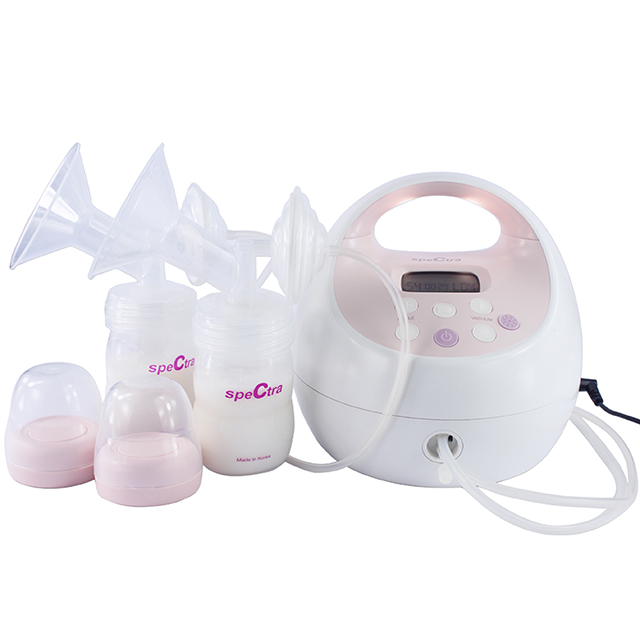
Troubleshooting your Spectra Breast Pump: When to Replace Spectra Breast Pump Parts

Today's consumer wants plug and play electronic equipment, but breast pumps require a little more preparation.
Getting Started

When you get your pump, remove the breast shield from the backflow protector.  Then remove the valve from the breast shield.  Sterilize only the following parts:  breast shield, valve, bottle, bottle ring, disc and cap.  Do not sterilize the filter aka backflow protector or tubing.  Sterilize using the top rack of the dishwasher, microwave steam sterilizer bag or boiling water.  If you use boiling water, bring the water to a boil and then leave in for no longer than 3-5 minutes or you will have cloudy or warped parts.  Do not use a bottle brush to clean breast pump parts.  Do not wash backflow protectors.  Keeping the filters dry, helps maintain their integrity longer.

Re-assemble as per instructions.  If you has misplaced your instructions, you can download these Spectra S2 breast pump instructions.  But remember, although these breast pumps have a closed system and when you purchase your own kit, you should not share these types of breast pumps with other mothers.  Although there is no cross contamination of yeast with a used breast pump, the motor is made to last for one baby and older pumps may compromise your milk supply.

Now that you have your breast pump re-assembled, set your pump to a fast speed and the highest suction level where you feel comfortable.  Too high of suction will not help the milk let-down if you feel discomfort.  Quick speed gives you the most cycles per minute which helps with milk production and double pumping increases prolactin levels which help with milk supply.  For a single baby pump for a full 10-15 minutes of double pumping even if milk stops flowing earlier.  This tells your body you want to produce more milk.  

Troubleshooting and Breast Pump Parts

The most common problem with low suction on your breast pump is the result of a part in your kit. To keep your pump functioning at optimum levels, replace the Spectra valves and backflow protectors every 100 pumping sessions.  For a mother who works 5 days a week and pumps 3 times per day, that is every 7 weeks.  The rule of thumb for the working mother is to replace these parts every 6-8 weeks. Other parts should be replaced as needed.  If you see pinholes in tubing, warped or scratched breast shields it is time to replace parts.  Other indicators are if you had a yeast infection as boiling will not kill yeast or if you see a tear in your valve.

It is important to keep replacement parts on hand so that a misfortune with a broken, melted or loss part does not interfere with your milk supply.  Having extra breast shields is also a good way to keep from spending as much time cleaning your parts.  Before you purchase extras however, make sure that the standard size is comfortable.  You should have space on at least one side of the pump shaft for your nipple to move freely while pumping.  If there is no space or you feel discomfort, consider purchasing the next size breast shield.  

Maintaining your breast pump is a proactive way to keep your milk supply, but don't forget to pump frequently and don't miss feeding sessions without pumping.  For moms with babies under 6 months, that is 8 times per day of feeding or pumping and over 6 months, you need stimulation 5 times per day.  Ensure an extra 3 pumping sessions during growth spurts which occur at 3 weeks, 6 weeks, 3 months and 6 months.  These extra sessions are a good reminder to replace your pump parts and step up your number of pumping sessions for the full 5-7 day growth spurt period.

Happy Pumping!
Tanya

Tuesday, July 26, 2016

Comprehensive Guide to Increasing Breast Milk Supply

Your body makes milk on a supply and demand basis. Although we don't need ounce markers on the side of our breasts to know the baby is getting enough, we tend to fret over milk supply.   Here is a comprehensive guide to ease your worries and address your concerns.

Is my baby getting enough?
When your baby is first born, his wet diapers should increase daily. On day one, he should have at least one, day two, he should have two, up until day six. After six days of age, they have six to eight pale wet diapers daily and three to four "cottage cheese and mustard" stools. Other ways we can tell the baby is getting enough milk is that he makes quiet swallowing sounds at the breast. The breast feel full before the feeding and softer afterward. The baby seems satisfied after twenty minutes of swallowing. Babies may loose 7-10% of their birth weight, but begin regaining at day 6 and gain 5-7 ounces per week on the average until 6 months of age. The stools can change at 4-6 weeks of age. Only if your baby is not gaining well, invest in a baby scale that you can use to monitor breast milk intake and growth. You will want a scale that shows 1/2 oz increments or greater.

Do I need to drink more water?
Water does not make milk, but make sure you are drinking to thirst. If you are dehydrated your body does not function optimally.  
Can I increase my milk supply with supplements?
If you want a boost increasing milk supply, there are several galactagogues on the market. Fenugreek is safe and effective and can be found in most areas. Make sure you are talking a quality brand like Nature's Herbs or Natures way in an appropriate quantity.  You should take 600-626 mg capsules that only contain Fenugreek.  This normally increases milk supply in about 48 hours.  If you are an average size mom, you should take three capsules, three times daily so 9 per day.  Plus size moms can take up to 5  600-626 mg capsules per dosage for a total of 15 per day.  Make sure you are not getting loose stools and check milk supply after 3 days by nursing the first session in the morning and then double pumping with a good quality double pump like the Hygeia EnJoye LBI, Spectra S2, or the Ameda Finesse Breast Pump for 15 minutes. 

How much is enough?
You should be yielding 2.5 oz per lb of baby's body weight per day.  To calculate if you are making the appropriate amount take your baby's weight for example 8 lb multiply by 2.5 which in this case would equal 20 oz per day.  Then divide by 8 times per day for a baby under 6 months.  This means from both breasts you should be making 2.5 oz for an 8 lb baby.  Here is a link to a page where you will find to an easy to read milk intake feeding supply chart.

Can my baby help increase my milk supply?
Yes!  If your infant will suckle at the breast, this is a highly effective way of increasing milk supply.  Offer the breast every 2 hours with a longer stretch at night for a minimum of 12 feedings per day.  If the infant will suckle for at least 20 minutes each time, your milk supply should increase by day 6.  Remember, breast milk adheres to the supply and demand rule, so the more you demand, the better the supply.

Can I increase my milk supply with a breast pump?
Yes!  If your baby will nurse frequently even if milk supply is low, use the baby; but if your baby will not latch or will not stay latched long enough for you to get adequate stimulation, by all means use a quality pump like the Hygeia EnJoye Cordless, Spectra S2, Ameda Finesse or the Ameda Platinum Breast Pump.  If your baby is under six months old, you should be pumping or nursing at least 8 times per day for 10-15 minutes of double pumping.
If you are already nursing eight times per day, use your breast pump to simulate a growth spurt.  Studies show that you need one hour of additional stimulation per day to increase milk supply.  Pump an additional 10-15 minutes three times per day for five days in a row to simulate a growth spurt and increase milk supply.  If you miss a day, start the process over. You can accomplish this by moving feedings and or pumping to every 2 hours instead of every three or pump.  Frequency is better than duration for increasing milk supply so don't cheat by making pumping times longer.  They need to be more often.

Are there other supplements that help with maintaining milk supply?
Motherlove More Milk Plus comes in a liquid filled capsule with just the right combination of galactagogues to increase milk supply in most mothers.  In addition, products from Motherlove offer specific instructions for dosage in relation to lactation.
There are several other supplements that I would recommend substituting for snacks. Instead of a cookie, grab a Milkmakers Lactation Cookie.  Moms do need an additional 500 calories per day to make milk.  Most of us get them instinctively, but if you are already over your calorie limit, a good mothers milk tea is a good option.  

Are there other tips for maintaining a healthy milk supply?
Busy moms can sometimes miss feeding and or pumping.  Don't just forget them, make up for missed pumping times at work when at home or put later in the day pumping closer together if you have a meeting.  If you are out for a short time and someone else is fed the baby before you could make it back, make sure to pump immediately upon return.  This helps milk supply as well as restocking your freezer.

Is my body capable of making enough milk?  
Insufficient milk supply syndrome is actually very rare.  A mother with a complete mastectomy on one breast can still nourish a baby just as a mother of twins can nourish two. Most milks supply issues are about mismanagement of stimulation of the breast and insufficient extraction of the milk, making your body think it doesn't need to make more.  
What other tips do you have for managing milk supply?

  • Nurse within the first 30 min to 1 hour after birth, delaying the bath for skin to skin contact.
  • Try to minimize engorgement and don't leave engorgement unresolved.  Nurse often, waking the baby every 2-3 hours.  Use warm compresses and a breast pump if the breasts are too hard for the baby to latch on.  The first day, the baby tends to sleep longer after the initial hour after birth, but continue to try and after that 6-10 hour period increase your efforts.
  • Don't miss feeding unless you are pumping.
  • Don't forget about growth spurts when you are working.  If you are away from your baby at the 3 week, 6 week, 3 month or 6 month time period, pump every 2 hours instead of every 3 for a total of 11-12 nursing or pumping sessions per day.
  • Delay solid foods until the baby had not only double his birth weight but is sitting alone unassisted.  Sitting without help (even from a Boppy) coincides with the loss of a tongue thrust reflex that indicates readiness for solids.
  • Feed solids only after breastmilk.  Breastmilk is still the main source of nutrition for at least the first year so do not fill the baby up on inferior food.  Nurse or give breastmilk first.  Besides, who wants green beans on your breast?

Here's to a healthy milk supply!
Tanya

References:
Fenugreek: One Remedy for Milk Production by Kathleen Huggins, RN, MS
Fenugreek: Overlooked but not Forgotten by Rima Jensen, MD

Updated:  2/19/19

Thursday, July 14, 2016

Breast Milk Intake Chart: Infant Weight - How Much Breast Milk

One of the top questions we get, is how much do I leave for my baby in a bottle when I am away at work?  After all, your breasts don't come with ounce markers because your baby feeds on demand.  But for moms who are working or away from their baby short term, it is important to know how to determine how much milk is appropriate to leave.  For infants up to six months old, the quickest way to determine this is to take your baby's current weight rounding up to the nearest half pound and multiply by 2.5.  For example, a baby who is 10 lbs will need 25 ounces per day.  Then divide by the number of feedings per day, normally 8 for an infant under six months of age.  Therefore 25 ounces divided by 8 feedings is 3.12 ounces per bottle which we will round up to the nearest quarter ounce.  In other words, leave 31/4 ounces for a 10 lb baby for every 3 hours that you will be away.  Also leaving an extra frozen bottle is a good idea for emergencies.  Here is a link to a breast milk intake chart for those of you who are like me and have a mental block when it comes to math.
Breast Milk Intake Chart
If you are trying to determine breast milk intake in those early days for your peace of mind or if your baby doctor is indicating that your baby is slow to gain weight, an affordable accurate baby scale with memory is a great tool.

Remember, diapers are a great indicator that your baby is getting enough.  Infants from day 6 through 6 weeks should have 6-8 wet diapers per day and 3-4 dirty diapers larger than a silver dollar.  Also note that older babies who are on solid food do not use this chart.  At that age, they take an average of 24-32 oz per day in addition to three solid meals per day.  When feeding solid foods, breastfeed first as breastmilk is still the main source of nutrition.  

If you still have concerns, having an affordable accurate digital baby scale is a plus.  Choose a digital baby scale that is accurate within 5 grams and has memory for before and after feeds to give you an idea of your baby's breast milk intake.

Best wishes!
Tanya

Thursday, June 16, 2016

Pump Up Your Production: Milk Supply and the Pumping Mama

With today's easy to use breast pumps, moms sometimes think they just need to pump at work at lunch and break and then just go about their business.  Pumping, just like breastfeeding should be intentional.  We don't choose to breastfeed because someone said it is better for your baby.  We breastfeed because we educate ourselves to want the best for our child.  Pumping should also not be so haphazard.

First choose a quality hygienic breast pump.
There are many breast pump out there that while commonplace, are not the best choice.  You need an auto-cycling breast pump that does at least 60 cycles and has a closed system like Hygeia, Ameda and Spectra offer.  Double pumping increases the prolactin levels as well as save you time. Prolactin is the milk producing hormone.

Next determine your pumping schedule.
A mother of an infant under six months should pump at least every 3 hours that she is away from her baby.  That time frame is from the beginning of one pumping or nursing session to the beginning of the next.  If your schedule is erratic, you should still pump 3 times per day on an 8 hour work day. Just put some of them closer together if needed to get this time in.

Allow enough time for pumping.
You should allow a full 10-15 minutes for double pumping and then an extra few minutes to rinse your parts and put them away.  Do not stop pumping if milk stops flowing unless the time on the clock has passed.  Otherwise your body will think you don't need as much milk.  A good rule of thumb is that if milk is flowing for less than 10 minutes, pump for 10. If it is flowing past the 10 minute mark, pump for 15.  These extra few minutes simulate the non-nutritive sucking your baby does when nursing and is imperative for milk supply.

Don't forget about growth spurts.
Infants nurse more frequently during growth spurts.  At 10 days to 3 weeks, the first growth spurt is evident with the baby asking to be fed more frequently.  Breast pumps don't cry to be used so we have to intentionally pump more often during this 5 day period.  Pumping every 2 hours is best during the baby's third week, sixth week and three month milestone.  If this is not possible at work, pump at home after feeding the baby at least three extra times per day.  Don't worry about the amount of milk you are extracting.  This is more for stimulation than extraction, indicating to your body that your baby is about to grow and will need more milk.

Maintain your breast pump.
Professional grade breast pumps like the Hygeia EnJoye, Spectra S2 have systems that are dependent on maintaining suction.  Replacing breast pump valves and filters every six to eight weeks is essential for keeping your breast pump working at it's optimal level.  Keep breast pump parts on hand and replace on schedule or more often if you notice evidence of decreased suction or damage to your parts.

With good information prior to embarking on full time pumping or working and breastfeeding it is entirely possible for you to maintain a healthy milk supply.

Happy Pumping!
Tanya


Monday, April 18, 2016

Pumping Schedule: Working and Breastfeeding


We get this question often as to how to ensure a healthy breast milk supply while working and breastfeeding.  Just as in raising kids, consistency is essential.  Most moms return to work when the baby is 4-8 weeks old so we will give you a typical schedule to keep you on track as well as a schedule for the early growth spurts.

This schedule is for a 24 hour period on any given 9-5 workday and can be modified to your changing schedule.  The imperative is to nurse or pump every 2-3 hours for a total of 8 times per 24 hour period when your baby is under 6 months old.  If you choose to delay solids past 6 months, then continue this schedule until solids are introduced.

Please note that we are not advocating scheduling a baby's every feeding.  Feeding on demand is best for milk supply so if your baby asks to be fed earlier that your normal "schedule" by all means, feed your baby.  We do however find that working mothers benefit from a routine when it comes to pumping to ensure that they do not miss feedings and therefore do not adequately stimulate the breast which lowers milk supply.

Sample Feeding - Pumping Schedule for Infants who Night Feed

6:00 am feeding

8:30 am feeding

11:30 am pumping

2:30 pm pumping

5:30 pm feeding

8:00 pm feeding

10:00 pm feeding

3:00 am feeding

Once the baby begins sleeping through the night, put daytime feedings/pumping closer together so that you still meet the 8 times per day minimum feedings.  

Sample Feeding - Pumping Schedule for Infants who Sleep Through the Night


5:00 am feeding

8:00 am feeding

11:00 am pumping

1:00 pm pumping

4:00 pm pumping

5:30 pm feeding

8:00 pm feeding

10:00 pm feeding


This schedule will vary when your baby is going through growth spurts.  PLAN on feeding or pumping every 2 hours for a total number of 11-12 times per day during the week that your baby is 3 weeks, 6 weeks, and the week that your baby turns 3 months old.  This will help ensure that your milk supply grows with your infant's needs.  For at least 5 days during that period, you will want your feeding and pumping schedule to look something like the one below:

Sample Feeding - Pumping Schedule for Infants During a Growth Spurt*


3:30 am feeding

5:30 am feeding

7:30 am feeding

9:30 am pumping

11:30 am pumping

1:30 pm pumping

3:30 pm pumping

5:30 pm feeding

7:30 pm feeding

9:30 pm feeding

11:30pm feeding


As a working mother, you should choose a quality closed system double breast pump such as Spectra, Hygeia or Ameda make.   The convenience of a hands-free pumping bra is nice.   Make sure that you are changing your breast pump valves and filters or backflow protector to keep your breast pump working at it's optimal suction levels.  Do not risk low milk supply by not replacing your breast pump parts.  Use a phone app timer or equivalent to make sure you pump for a full 10-15 minutes of double pumping whether milk is coming out or not.  The law of supply and demand when it comes to breastfeeding is more like DEMAND and then the SUPPLY will come!  

Happy Pumping,
Tanya


*Growth spurts typically occur either at 10 days or 3 weeks, and then recur at 6 weeks, and 3 months and last for 5-7 days.

Tuesday, March 8, 2016

ARDO & Lucina: Finding Breast Pump Parts for ARDO Calypso and Melodi Breast Pumps

In helping moms find breast pump parts for their insurance pumps, we noticed a similarity between the Lucina Melodi and ARDO Calypso breast pump parts.  In investigating further, we contacted Lucina whose chat rep denied such a connection.  You be the judge.  The parts are identical except the color of the cap on the double pump kit that fits on the flange.  While Lucina Melodi Advanced and Melodi Prime have a purple cap, ARDO Calypso and Carum use a green cap. We further noticed that the ARDO Amaryll manual breast pump is the exact same pump as the Lucina Melodi Manual Pump.


Finally, we took a close look at the Lucina Double Pump Kit image on their website and we noticed that you can read part of the ARDO brand name on the side of the flange shaft.  


Our conclusion is that the parts are made by the same company and can be used interchangeably. Good news for the mom who can't find Lucina Melodi breast pump parts!  We would love to get your feedback on using the ARDO parts on your Lucina Melodi Advanced or Melodi Prime breast pump!  

Happy Pumping,
Tanya


Monday, February 15, 2016

When & How to Use a Nipple Shield

Nipple shields have changed over the years.  You will find videos and images of rubber or latex nipple shields which are no longer used due to their thickness. Latex is also no longer used since it has a tendency to break down, has a smell and a taste and is an allergen to some.

Modern nipple shields are silicone.  Medela even made them with a cut-out which was supposed to be used for more skin to skin contact with the baby's chin or if flipped the other direction to prevent possibly obstructing the infants airway.  Since these "contact" style have less surface area, they do not adhere as well as a full circle design such as the Ameda Nipple Shield.

When is the use of a nipple shield indicated?

1.  When a mom has an inverted nipple and the baby does not latch or suck because it does not feel the nipple in its mouth.  Some nipples are easily identified as inverted, but others only invert when the baby tries to latch.  An easy test for this is to take your index finger and thumb and compress the areola 1" behind the nipple.  If the nipple goes in, it is indeed flat or inverted even if it appears to protrude upon inspection.

2.  When a mom has a flat nipple or a nipple that "hides" when compressed as explained above.

3.  When a baby is bottle confused and does not identify a fleshy nipple as it's trigger to suck.  Depending on how long the baby is on a bottle, moms can train the infant to go from bottle to nipple shield and then to breast in the following steps:
     a.  For the first 24 hours, use a wide mouth bottle nipple on the baby's bottle, but turn the baby in tummy to tummy held tightly to feed.  Babies who are used to feeding on their backs tend to fight you when you hold them tightly at first so this is the first step to getting back to the breast.
     b. Wet the nipple shield with your own expressed milk to help it adhere.  You can even take a syringe and squirt some milk into the tip of the nipple shield so that babies who are used to immediate gratification from a bottle will continue to suck.
     c.  After using the nipple shield to get the baby to feed from the breast, try removing it after the feeding has started.

When should I not use a nipple shield?

A nipple shield is a last resort.  It is not the first thing to try when you have a sore or abraded nipple.  If the nipple is sore, it is most likely a poor latch and that needs to be corrected.  Using a nipple shield for a poor latch is not indicated.  See our blog post on correcting the latch instead because a nipple shield used incorrectly can cause more problems down the road as discussed below.

How long should I use the nipple shield?

Nipple shields were intended for short-term use as a bridge to help a mom with a flat or inverted nipple until the baby has a strong suck.  Or to help a bottle-confused baby nurse at the breast.  This short term should last no more than a few weeks.  It you use a nipple shield for longer than a few days, it is important to pump 2-3 times per day with a good double electric breast pump after feedings.  This will offset the decrease in stimulation and milk supply that a nipple shield can cause. 

How can I wean my baby off the nipple shield?

1.  Try removing the shield after the first 2-3 minutes of the feed.
2.  Try feeding the baby when she is in instinctive mode such as half-asleep or in the bathtub without the nipple shield.
3.  Buy a second nipple shield, invert it and take a sliver off with a clear sharp razor each day until the tip is gone.  Make sure you invert the shield and you do not use the only one you have in case your baby has a bad feeding in the middle of the night.  Inverting the shield before slivering it keeps any uneven edges towards you and not towards the baby.

What if my baby refuses to get rid of the nipple shield?

If the baby refuses to nurse without the nipple shield, it is not the end of the world.  Many moms who did not try a nipple shield for a baby who refused to latch, end up exclusively pumping.  Therefore pumping 2-3 times a day after feeding is much easier than pumping 8 times per day.  Your baby will still benefit from the tooth and jaw development that occurs when they are directly at the breast and of course whether you are pumping or nursing, the benefits of breast milk are immense. 

Best wishes, Mamas!
Tanya


Eufy vs Perifit Wearable Breast Pump